Updates
·
Advancing Molecular Docking: gnina is Now Available on Vecura
This update integrates the deep-learning-augmented docking tool gnina into Vecura, enabling researchers to perform advanced, CNN-powered molecular docking without the need to manage complex infrastructure or GPU acceleration.
Vecura Team

What is gnina?
gnina is a powerful, deep-learning-augmented molecular docking engine that integrates Convolutional Neural Network (CNN) scoring directly into the established AutoDock Vina-style docking pipeline. By encoding protein-ligand complexes as 3D voxelized grids, it allows the model to evaluate binding poses using spatial features rather than relying solely on traditional, hand-crafted empirical energy terms. It is especially useful for structure-based drug discovery, where distinguishing biologically relevant poses from near-misses is a constant challenge.
What can users do with gnina on Vecura?
With gnina on Vecura, users can:
Perform robust global molecular docking to predict how small molecules bind to specific protein targets.
Refine existing ligand poses through local energy minimization (BFGS) for quick geometry optimization.
Utilize CNN-based scoring to more accurately rank binding poses and predict binding affinities (pK units).
Streamline complex docking workflows by managing protein structures and ligand libraries within an integrated, no-setup-required environment.
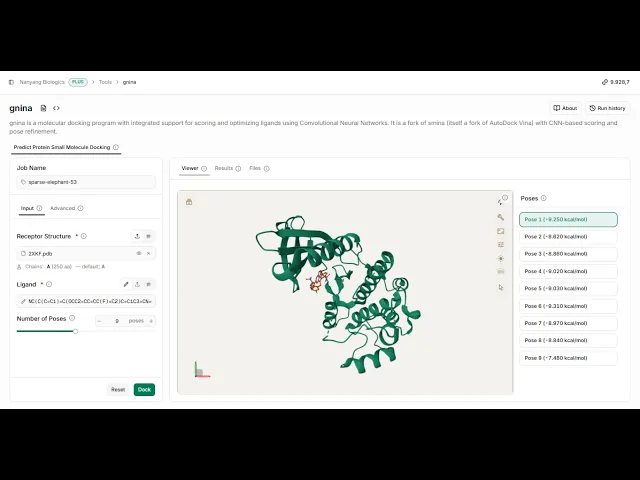
gnina model on Vecura
What the output means
The output provides ranked binding poses in an SDF format, supplemented by comprehensive tables containing Vina-style affinity scores, CNN pose-confidence scores, and predicted binding affinities. This output should be used to support scientific decision-making, helping researchers prioritize compounds for further study. It does not replace experimental validation.
Why this matters
Traditional scoring functions often struggle to capture the complex, non-linear interactions between ligands and protein binding sites, leading to high false-positive rates in virtual screening. By leveraging deep learning to learn these spatial patterns from experimental data, gnina provides a higher-fidelity approach to pose prediction and affinity estimation, particularly for targets that are poorly served by classical methods.
Integrating this capability into a user-friendly platform like Vecura removes the technical overhead of managing GPU-accelerated environments and complex dependency chains. This allows medicinal chemists and structural biologists to focus on evaluating high-quality binding hypotheses rather than troubleshooting computational pipelines.
Developed by: The Gnina research group (McNutt et al.)
Source:Official GitHub Repository