Updates
·
Accelerating Fragment-Based Lead Optimization with DeepFrag2 on Vecura
This update enables computational scientists and medicinal chemists to streamline fragment-based lead optimization through a guided, accessible workflow inside Vecura, eliminating the need to manage complex underlying technical infrastructure.
Vecura Team
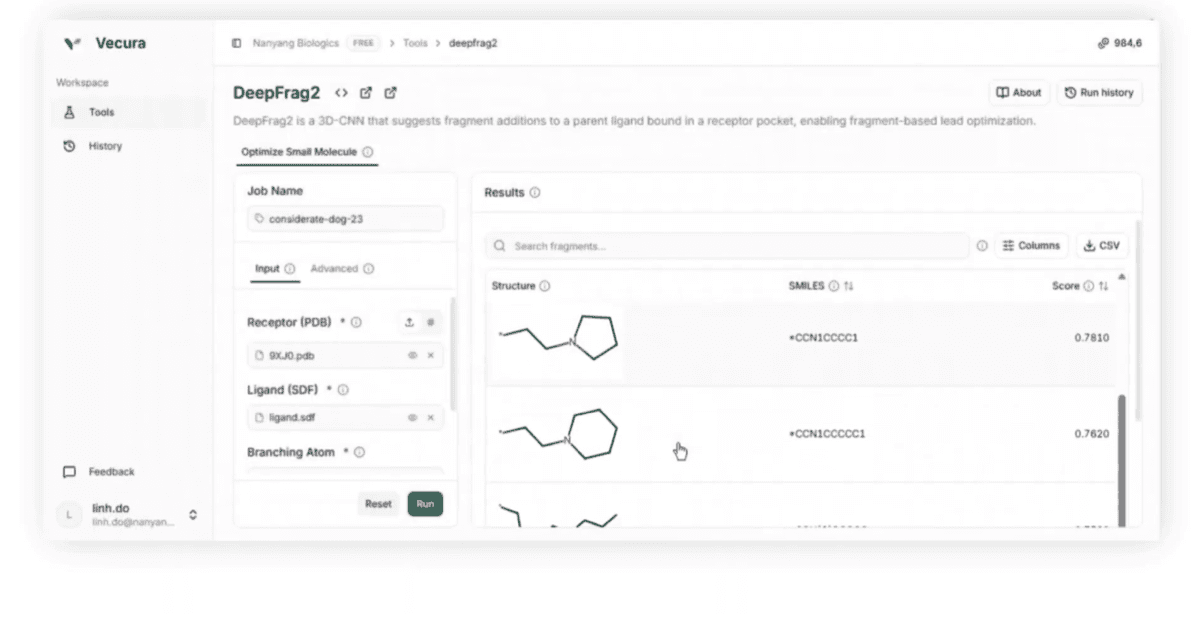
What is DeepFrag2?
DeepFrag2 is a machine-learning tool for structure-aware lead optimization through fragment addition and replacement. It uses 3D protein–ligand complex information to predict chemically relevant molecular fragments that may improve binding affinity and drug-like properties. It is especially useful for medicinal chemists optimizing small-molecule leads against specific protein targets or receptor classes.
What can users do with DeepFrag2 on Vecura?
With DeepFrag2 on Vecura, users can:
Predict optimized molecular fragments for lead compounds
Perform fragment addition or fragment replacement workflows
Select targeted models based on fragment size or chemical properties
Run receptor-specific optimization using fine-tuned protein-family models
What the output means
The output provides predicted fragment fingerprints, ranked fragment recommendations, cosine similarity scores, and Top-K candidate matches from a curated fragment library.
This output should be used to support scientific decision making. It does not replace experimental validation.
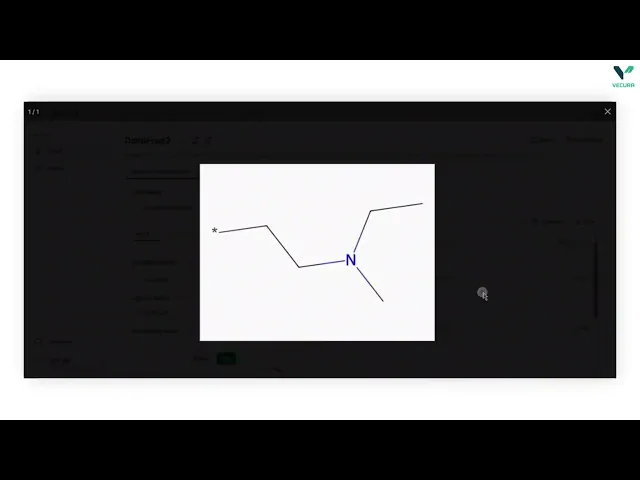
DeepFrag2 demo on Vecura
Why this matters
Lead optimization is one of the most resource-intensive stages of drug discovery. Researchers often need to synthesize and evaluate many analogs before identifying compounds with the right balance of potency, selectivity, and pharmacokinetic properties. DeepFrag2 helps accelerate this process by using deep learning to recommend chemically meaningful fragment modifications directly from 3D protein–ligand structures.
Unlike fully generative molecular design systems, DeepFrag2 predicts fragment fingerprints that are matched against curated fragment libraries. This allows medicinal chemists to constrain recommendations to synthetically feasible, purchasable, or pharmacologically desirable chemical fragments. The platform also introduces domain-specific models trained on fragment size, aromaticity, acidity/basicity, and protein-family specialization, improving prediction accuracy for targeted optimization campaigns.
Developed by: Jacob D. Durrant and the Durrant Lab
Source:DeepFrag2 Official Website